THE LANDOWNER'S GUIDE TO EVTOL FLYING: HOW MUCH LAND DO YOU ACTUALLY NEED?
BY THE RISE VERTICAL TEAM · YIVTOL'S TOP-TIER USA PARTNER · OTTAWA, ILLINOIS
THE SHORT ANSWER
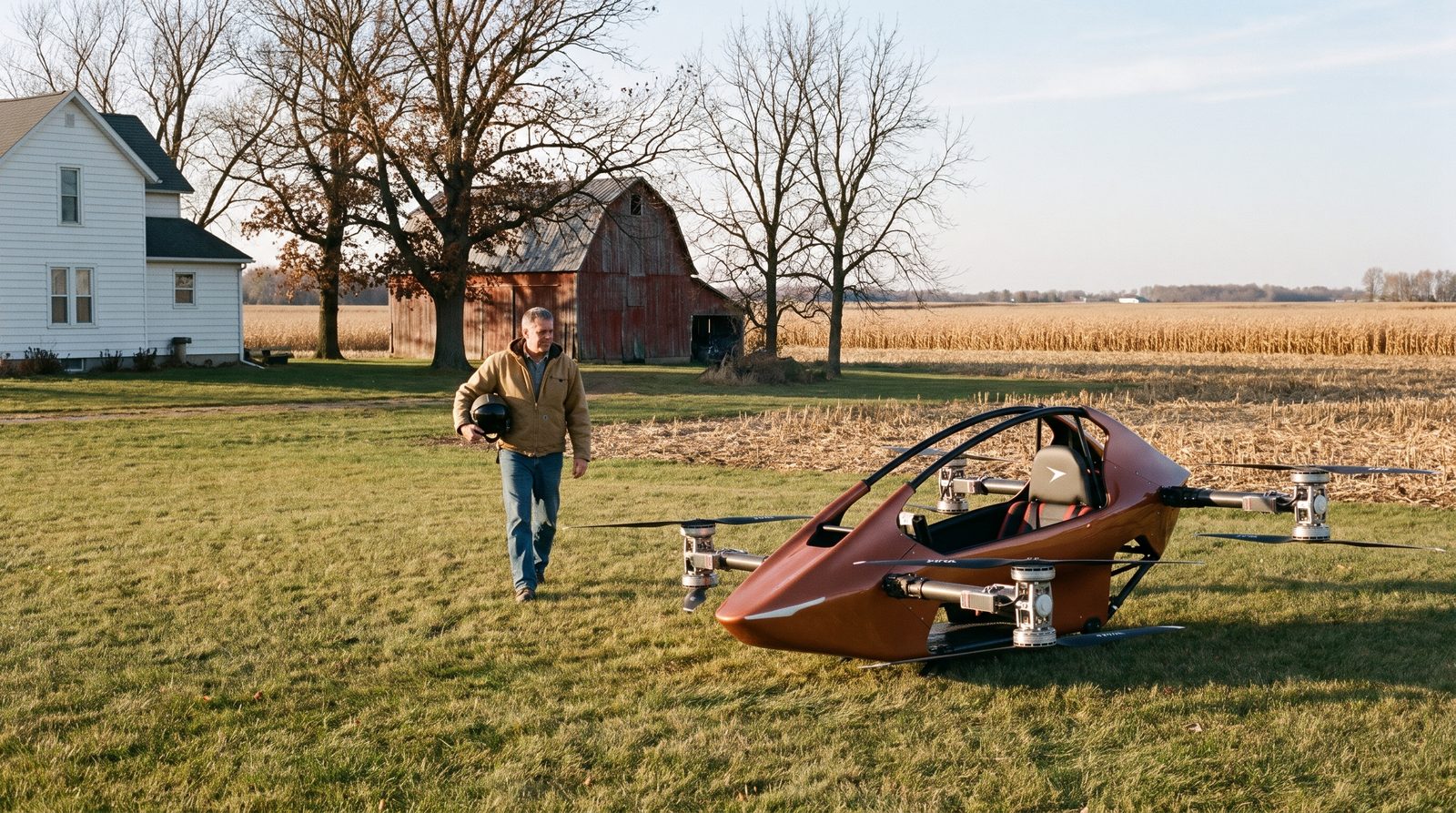
For many rural and semi-rural properties — yes, your land can be your airfield. Part 103 ultralights are particularly well suited to Class G uncontrolled airspace, which covers most open country in America, and because the S-Zero lifts off vertically, there is no runway to build and no FAA minimum acreage to meet. What you need is a safe, open area clear of wires, trees, structures, and people — and an understanding of the airspace and operating rules that apply over your grass.
THE RUNWAY QUESTION, DELETED
For forty years, the honest answer to "can I fly from my own land?" started with a runway. Traditional fixed-wing ultralights need a few hundred feet of smooth, mowed, into-the-wind strip — which quietly ruled out most properties and sent owners back to airfields. A vertical-takeoff aircraft deletes that math. The S-Zero rises straight up from a patch of lawn and lands on the same spot, so the infrastructure requirement collapses from "airstrip" to "clearing." That one change is why the landowner — not the airport renter — is the natural eVTOL owner.
HOW MUCH LAND DO YOU ACTUALLY NEED?
Here's the part most articles get wrong: the FAA sets no minimum acreage. Part 103 regulates how and where you operate — not the size of your deed. So the real question is clearance, and clearance is about what's around your takeoff spot:
- An open lift zone. A reasonably level area of grass or firm ground with nothing overhead — no wires, no branches, no eaves. If you can picture a large circle of clear sky above it, you're thinking correctly.
- Margin from everything that matters. Comfortable distance from your house, outbuildings, roads, livestock, and anywhere people gather. More margin means more forgiveness while you're learning.
- Clear directions of travel. At least one or two open directions to climb out and return without threading obstacles — a back pasture, a harvested field, a tree-lined but wide meadow.
- Somewhere to set down. Open ground within reach where you could land early if weather or judgment says so. Flat rural country is generous with this by default.
In practice, owners with a few open acres have everything they need, and larger rural parcels are effectively private airparks. If your property hosts a riding mower comfortably, it's worth a serious conversation — and during at-home training, your factory test pilot walks your land with you and picks the exact spots.
YOU OWN THE GRASS. WHO OWNS THE SKY?
The airspace above your land belongs to the national airspace system, and that's actually good news — because most open country in America sits under Class G uncontrolled airspace, exactly where Part 103 ultralights are best suited to operate. Operations in certain controlled airspace require prior authorization from the air traffic control facility with jurisdiction, so the first homework item for any landowner is simple: find out what's above you. A free sectional chart (SkyVector works in any browser) shows whether you're under plain Class G or near an airport's controlled airspace. Rural Illinois, like most of the rural Midwest, is overwhelmingly the former — one of the reasons we're based in Ottawa and not Chicago.
THE RULES THAT FOLLOW YOU HOME
Flying from your own land doesn't exempt you from Part 103 — it just makes compliance easy. The same operating rules apply over your pasture as anywhere else: daylight hours (limited civil-twilight operation may be permitted with the applicable lighting), no congested areas or open-air assemblies of people, visibility and cloud-clearance minimums, and one occupant. None of these pinch on a rural property — which is rather the point. Our plain-English Part 103 guide covers the full rule set, and the FAQ has the quick version.
NEIGHBORS, NOISE, AND BEING THE GOOD KIND OF FAMOUS
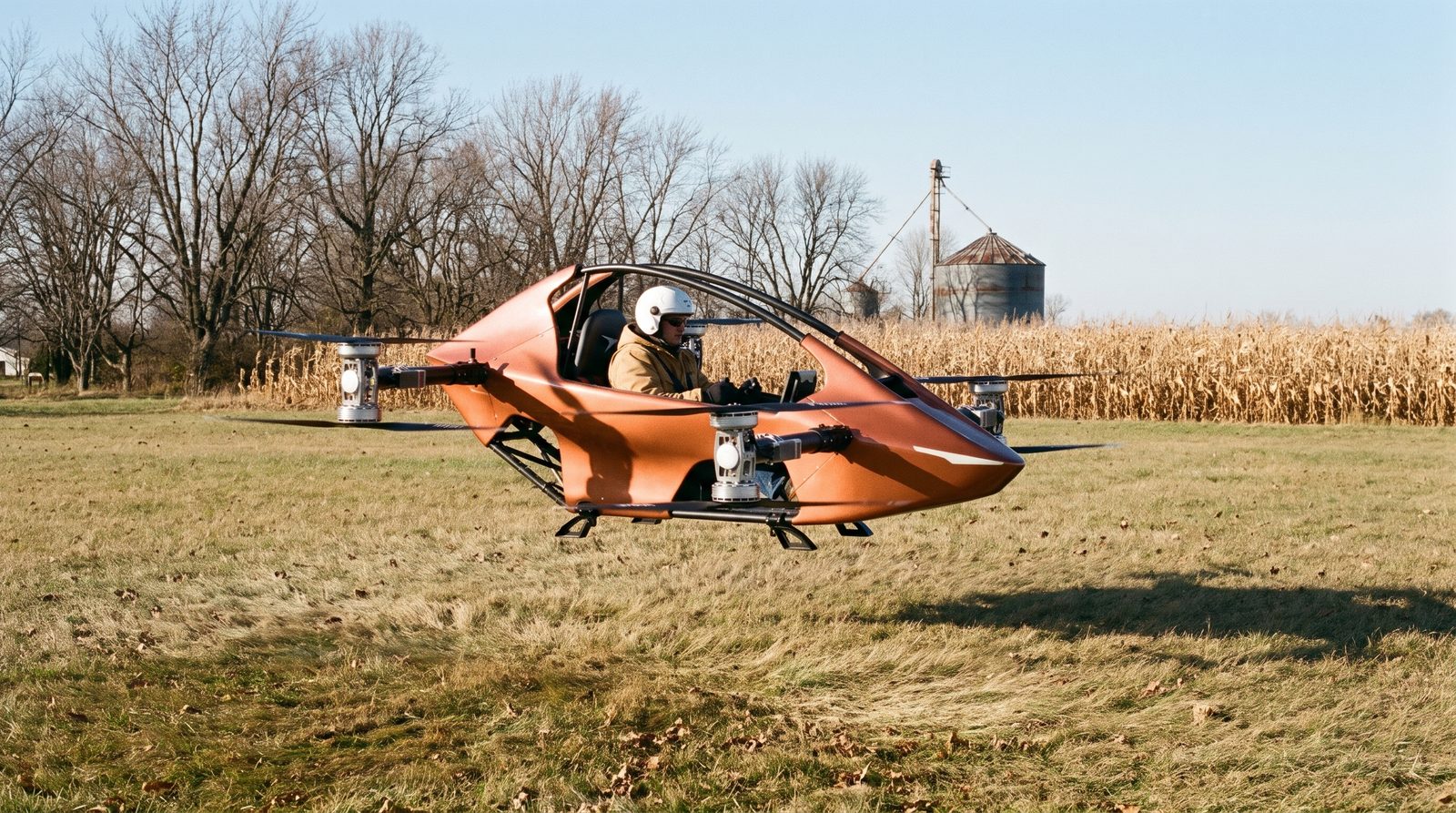
The question behind the question is usually: what will the neighbors think? Here the electric part of eVTOL does quiet, literal work. A gas two-stroke ultralight announces itself for miles; the S-Zero's electric rotors produce a hum that fades fast with distance — closer to a drone than a chainsaw. Add considerate habits — climb out over your own open ground, don't orbit the neighbor's house or spook their horses, keep early-morning flights gentle — and most owners report the opposite of complaints: lawn chairs appearing along the fence line. One honest footnote: flight is federally regulated, but ground-side matters like storage and land use can touch local rules in some areas. Rural and agricultural land is rarely an issue; if you're in an HOA, spend ten minutes checking before delivery day.
WHY THE MIDWEST IS BASICALLY BUILT FOR THIS
Flat horizons, big parcels, Class G skies, and a culture that already keeps serious machines in barns — the rural Midwest is the most eVTOL-ready landscape in America, and November proves it: harvested fields turn into miles of open, forgiving country. You store the aircraft in the garage or barn you already own, charge it from an outlet, and your "drive to the airport" is a walk across the yard. Pair that with published pricing and factory training at your home, and the distance between "interesting idea" and "flying over my own land" is shorter than it has ever been.
QUICK ANSWERS
How many acres do I need to fly an eVTOL from home?
There's no FAA minimum acreage — the regulation cares about how and where you operate, not how big your deed is. What matters is safe clearance: an open, obstacle-free area to lift off and land, comfortable margin from buildings, wires, roads, and people, and somewhere sensible to set down if you ever need to. A few open acres makes all of that easy; many rural properties qualify comfortably.
Do I need a runway or landing strip?
No. The S-Zero takes off and lands vertically, so the runway requirement that shaped traditional ultralight ownership simply doesn't apply. A reasonably level, open patch of mowed grass clear of wires and trees is the whole infrastructure requirement.
Do I need FAA permission to fly from my own property?
Qualifying Part 103 ultralight vehicles do not require standard FAA aircraft registration, an airworthiness certificate, or a pilot certificate — but the aircraft and the operation must meet the applicable Part 103 requirements and limitations. Operations in certain controlled airspace require prior authorization from air traffic control, which is why checking the airspace over your land comes first.
Can I fly over my neighbor's property?
The FAA governs the airspace, not your property line — but Part 103 restricts operations over congested areas and open-air assemblies of people, and good airmanship means planning flight paths that stay over open ground, your own where practical. Most owners find their neighbors become their biggest fans precisely because they fly considerately.
What about HOAs, zoning, or local ordinances?
Flight itself is federally regulated, but what happens on the ground — where you take off from, store, or charge an aircraft — can touch local land-use rules in some areas. Most rural and agricultural properties have no issue at all; if you're in an HOA or close to town, it's worth a quick check before delivery day.
Where do I store it — do I need a hangar?
No hangar, no airport tie-down, no monthly fees. Owners typically store the S-Zero in a garage, barn, or enclosed trailer on their own property, charging from a standard outlet. Your land is the airfield and your outbuilding is the hangar.
General information as of November 2026, not legal or regulatory advice. FAA regulations, airspace classifications, and local rules vary by location and may change. To operate under FAA Part 103, the aircraft and its operation must meet the applicable requirements and limitations. Owners and operators are responsible for verifying the airspace over their property and complying with current FAA regulations, manufacturer limitations, and applicable local rules.